

Clara Morgane and the revue Fantastic: three days of glamour, sisterhood, and raw emotion at Cabaret de Licques
At the end of the local road winding through the pastures of the Pays de Licques, the great curtain of mist parts to reveal a facade illuminated in gold and crimson. During this All Saints’ Day weekend—October 30, 31, and November 1—a singular scent of excitement hung in the air. The license plates lined up in the parking lot already told the story: from Pas-de-Calais to the Lille metropolis, from the Somme to the borders of Belgium, the public had answered a rare call. It was the meeting between a popular icon of French glamour and the permanent troupe of a cabaret of pure craftsmanship, anchored in its land but resolutely focused on the grand spectacle.
For three consecutive performances, all played to sold-out houses where not a single folding seat remained empty, Clara Morgane shared the stage with the revue Fantastic. But what the audience came for—and what they took straight to their hearts—went far beyond the simple appearance of a distinguished guest. It was a moment of old-fashioned live performance: vibrant, generous, unfiltered, where the notion of sisterhood ceased to be a trendy slogan and became the driving force of a high-octane show.
The antidote to gloom: when the music-hall rediscovers its primary purpose
Entering a cabaret hall at a time when the days are shortening and current events weigh heavy on the shoulders is almost an act of gentle resistance. From the lobby, the clinking of champagne flutes and the joyful hum of conversation set the tone. The round tables brought together a fascinating sociology: couples celebrating silver weddings, groups of women in their fifties enjoying a moment of freedom, curious thirty-somethings discovering modern music-hall, and grandmothers accompanied by their grandchildren.
“In these complicated times, I find that the Cabaret has this unique power to restore magic, and I hope with all my heart that you were able to receive all that magic tonight.” When Clara Morgane spoke these words into the microphone at the end of Saturday night’s performance, she was merely naming what the entire room had been feeling since the first notes of the opening.
The cabaret has never been a simple matter of quick consumption entertainment. Born in the Parisian suburbs to defy the grey skies and bring lonely souls together, it retains, when embodied with sincerity, this raw power of collective elevation. In Licques, the formula took on its full meaning: offering a bubble where the beauty of the gesture, the elegance of the line, and the brilliance of the lights provide lasting warmth to those who settle in.
Total immersion at the heart of the Fantastic show
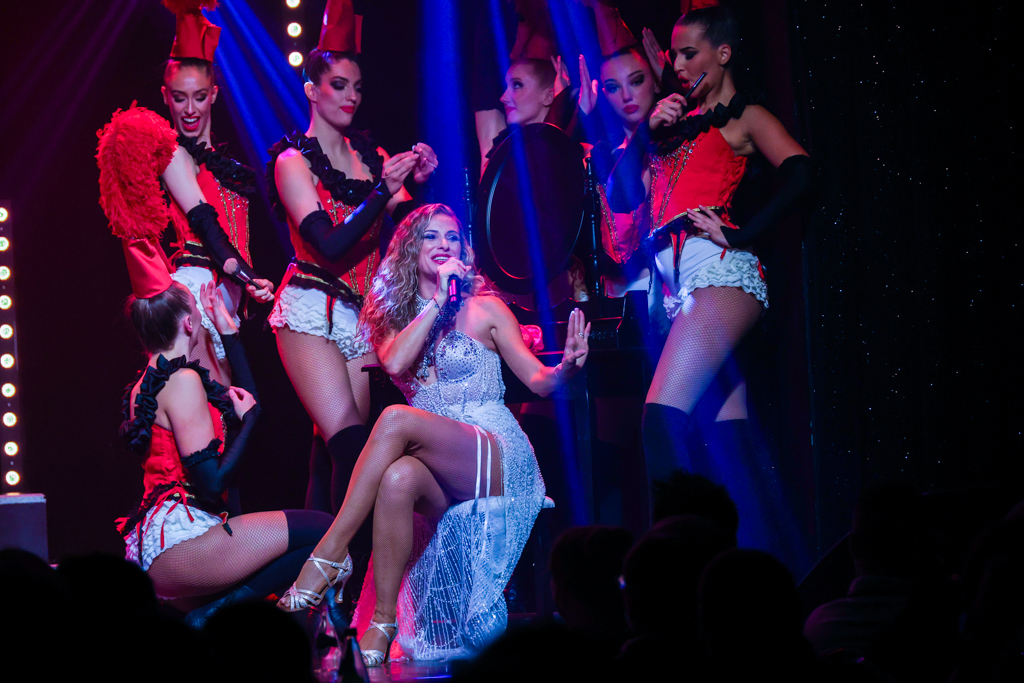
The temptation for a guest personality in a regional revue is often to settle for a few conventional appearances, protected by a polite distance. From the moment she stepped onto the stage, Clara Morgane swept this fear aside. Dressed in creations blending the precision of openwork lace and the shimmer of crystals, she plunged heart and soul into the meticulously timed dynamics of Fantastic.
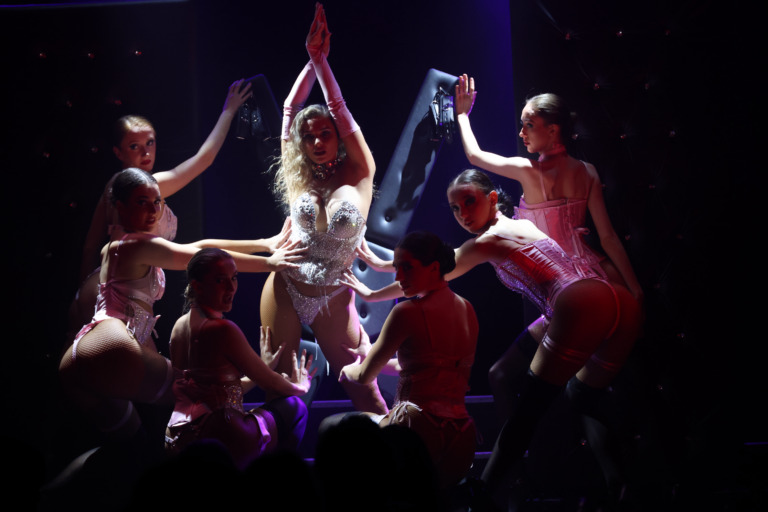
The revue did not stop to watch her pass; it expanded to welcome her. The scenes followed one another with disconcerting fluidity, alternating between frenetic rhythms and poetic breathers. The entire female ballet corps of the Cabaret de Licques formed a close guard around her with manifest complicity. No crushing hierarchy, no forced erasure: a mutual enhancement.
In the most daring choreographies, where sexiness meets high technical precision without ever tipping into gratuitous provocation, an aesthetic of French-style glamour unfolded. The glances exchanged between the dancers on stage reflected a shared pride: that of celebrating femininity in its power, its elegance, and its insolent freedom.
From the hushed to the brassy jazz: the musical embodiment of a free artist
Beyond the public image and visual magnetism, the weekend served as a reminder of a reality that some spectators were discovering live: Clara Morgane is a singer of formidable sensitivity, whose suave timbre and sense of phrasing flourish fully in the acoustic atmosphere of a hushed theater.
“50 nuances de bleu”: the confidence shared with Pascal Obispo
The silence that fell over the room during the first notes of this track marked one of the emotional peaks of the three days. The result of a close artistic collaboration with Pascal Obispo, this delicate composition revealed an intimate, almost vulnerable Clara. Under a cobalt blue light that sculpted her silhouette in the shadows, her voice distilled a melancholy poetry of great accuracy. The audience held its breath. No one was taking photos, no one was clapping yet: we were listening, suspended on a melody tailor-made for late-night confidences.
“Comme un boomerang”: the jazz-cabaret explosion
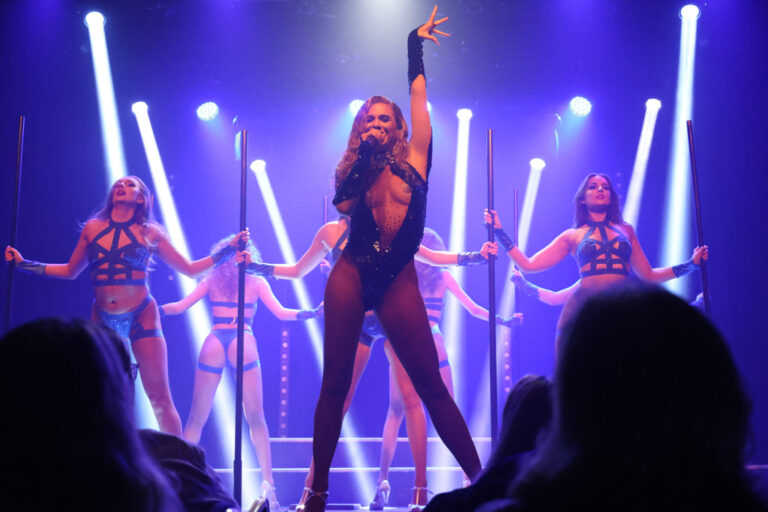
The counterpoint was not long in coming. Re-orchestrated for the revue, the poisonous anthem written by Serge Gainsbourg and immortalized by Étienne Daho was adorned with brassy jazz arrangements of delightful vivacity. Far from the original pop restraint, the version offered in Licques took on the air of an unbridled swing party. Sharp trumpet riffs, marked offbeats on the snare drum, and a sparkling, complicit stage presence with the audience: Clara took hold of the track with an elegant cheekiness that lifted the room, provoking waves of rhythmic clapping from the very first chorus.
Vertigo and bursts of laughter: the artistic cast of Licques at its peak
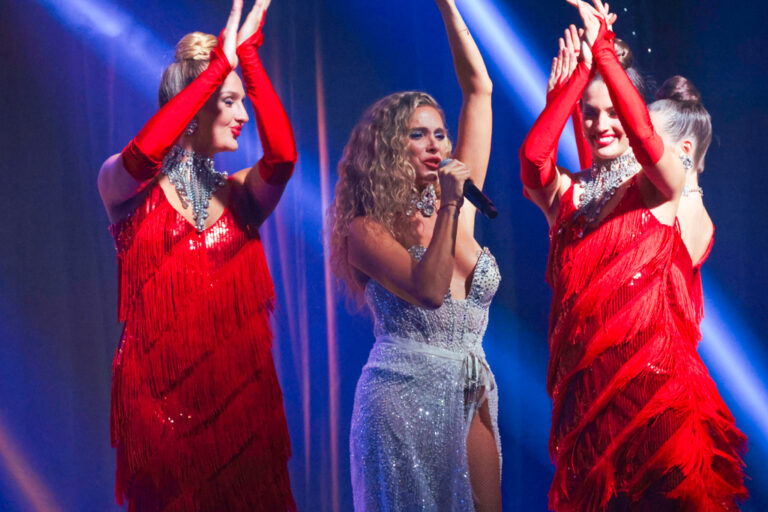
A great show never rests on a single headliner. The strength of these three days rested precisely on the mastery of the permanent artists of the Cabaret de Licques, who offered the public rushes of adrenaline and moments of flawless virtuosity.
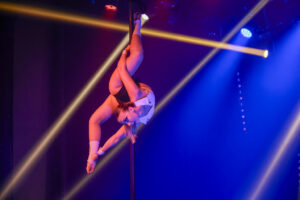
Shanon’s magnetic weightlessness
One had to see the reaction in the aisles when Shanon stepped toward the vertical acrobatic pole dance bar. Far from any cliché, the artist transforms this discipline into an aerial ballet of Olympic rigor. Suspended several meters high, held only by the pressure of a thigh or the strength of a wrist, she defies the laws of gravity with a calculated slowness that borders on pure illusion. The contrast between the Herculean muscular power required by the figures and the infinite softness of her movements left the room speechless with admiration, before a standing ovation greeted the feat.
Lucas: humor, rhythm, and gentle madness
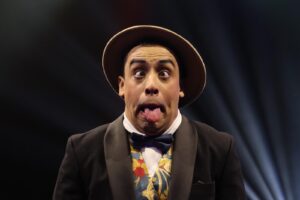
At the other end of the emotional spectrum, Lucas established himself as the conductor of laughter. A gifted juggler, unpredictable musician, and master of self-deprecation, he possesses that rare art of popular music-hall: establishing immediate proximity with any audience with a simple raise of an eyebrow. Whether manipulating his clubs at breakneck speed or transforming a feigned incident into a hilarious comedy sequence, he knew how to defuse the solemnity of the stage to create a direct and complicit bridge between the artists and the spectators.
The essential French Cancan: the final hurricane
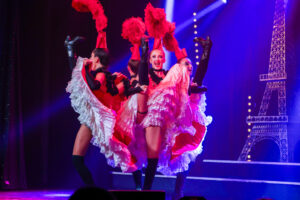
Finally, it is impossible to close a revue without paying tribute to the father of all music-hall ballets. When the first violin chords of Offenbach snapped, the ballet corps swept onto the stage in a whirlwind of multicolored ruffles. Joyful cries, perfectly timed leg kicks, cartwheels executed in perfect synchrony, and jump splits to the floor: the energy deployed literally shook the room, reminding us why the Cancan remains, for over a century, the most delightful collective trance act in the world.
“Anatomy of a Metamorphosis”: the woman behind the artist
Those lucky enough to attend one of the three performances will long remember the after-show. While the curtain had been closed for over an hour and technicians were already busy backstage, Clara Morgane did not leave through a side door.
Seated in the heart of the hall for a session of exchanges and signings, she took the time to listen to every spectator. Young women coming to tell her what her journey had inspired in them, mothers asking for a personalized note for their daughters, men touched by her natural kindness: the face-to-face lasted well beyond what usual promotional schedules provide.
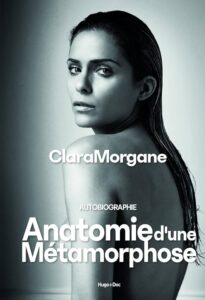
The artist spoke at length about her latest book, Anatomie d’une métamorphose. This autobiographical work, written without pretense or facade, tells the story of a woman’s struggle to take ownership of her destiny, refuse the labels society imposes, and build her emancipation in an often ruthless media universe. The discussions around this book resonated strangely with the very spirit of the Cabaret de Licques: a place where one assumes who they are, where the body is not a taboo but a source of wonder, and where freedom is affirmed through creation.
The art of live performance: when proximity makes all the difference
This exceptional visit highlighted what constitutes the deep DNA of the Cabaret de Licques within the cultural landscape of Pas-de-Calais and the Hauts-de-France region.
In mega-concert halls or impersonal arenas, the spectator watches a star from a giant screen fifty meters away, caught in an anonymous mass. At the Cabaret de Licques, the experience is physical, intimate, and tactile. You hear the breath of the dancers on stage, you perceive the quiver of feathers with every jump, you catch the eyes of the artists during a solo, and you share a meal prepared with noble local products before the party begins.
This All Saints’ Day weekend will remain in memories as a brilliant demonstration that a great popular show does not need distant artifice to touch the sublime. It needs talent, heart, invisible hard work, and that inextinguishable desire to make the eyes of those who pushed through the door shine.
Frequently Asked Questions: looking back at the Clara Morgane event in Licques
What show did Clara Morgane perform at Cabaret de Licques?
Clara Morgane was the guest of honor for the grand revue Fantastic. She took part in group scenes alongside the ballet corps, performed musical tracks live, and participated in the cabaret’s festive finale.
What songs were performed on stage during the show?
The audience heard the intimate track 50 nuances de bleu, composed and co-written with Pascal Obispo, as well as a high-energy jazz reinterpretation of the famous classic Comme un boomerang by Serge Gainsbourg and Étienne Daho.
What were the highlight acts of the Fantastic revue?
In addition to Clara Morgane’s appearances, the audience was captivated by Shanon’s aerial acrobatic pole dance act, Lucas’s humor and visual juggling sequences, and the traditional French Cancan performed by the ballet corps.
How did the meeting with the public go at the end of the show?
After each performance, Clara Morgane remained in the hall to talk at length with the spectators, pose for souvenir photos, and sign her autobiographical book Anatomie d’une métamorphose.


